This is one of my favorite works by Matthew - Artist, Co Director of Fabrica Gallery and all round lovely chap, who sadly passed away recently. Both his contribution to the world and the void he leaves behind are far too extensive for me to write here, so I will just say...
Enjoy his work.
Ponderosa 2010 from Matthew Miller on Vimeo.
Map Room - Ponderosa from Matthew Miller on Vimeo.
To find out more about matthew's work
http://matthew-miller.co.uk/selected.htm
http://fabrica.org.uk/
Wednesday, 29 June 2011


Drawn to the Beat @ Fabrica
 |
| Drawn to the Beat, Fabrica Gallery, Brighton, May 14th 2011 8-10pm |
Following on from my work Drawn to the Beat @ Band on the Wall, Manchester, January 2011 this new event was commissioned by Fabrica Gallery, Brighton - to be developed in response to the gallery’s then current exhibition The Forty Part Motet by Janet Cardiff, an artist I have always been interested in and researched her practice as part of my M.A. The relationship between sound and body, narrative, a play on fact and fiction and a multi sensory environment are all important parts of her work, and my own. To be able to create work for a gallery I have great respect for and am so at home in (I have worked with Fabrica in various roles since 2002), as well as responding to Cardiff's work was really exciting.

About The Forty Part Motet – ‘The Forty Part Motet is a sound installation by Canadian artist, Janet Cardiff based on the renaissance choral music Spem in Alium (1573) by Thomas Tallis. Forty separate voices are played back through forty speakers; each placed torso-like in clusters of five and aligned in an oval.’ Fabrica exhibition archive - The Forty Part Motet


My main focus in developing this work was ‘curating music’, I had learnt a lot about creating the right environment for listening and response (the physical space, and my role within the event) during the first Drawn to the Beat. Here I wanted to take the focus a step beyond a mechanism for listening/drawing, and play more with the content of what would be heard. Taking Cardiff’s piece as a starting point I selected music that focused on, the human voice, something I have been exploring recently through my own drawings, with Najia Bagi and the Manchester Halle Choir. Follow this link to find out more about my collaboration with musicians http://deadrabbit-ablog.blogspot.com/2011/06/new-collaborations-new-drawings.html
The voice is a broad remit of course, and the resulting collection of music traveled across continents, time and genres. The majority featured the collective human voice, alternative choirs if you like, from hip-hop to Bolly-wood. some of it commented on the religious content of the Tallis piece and the more obvious associations evoked by having this piece in a gallery space that is a former church. The common thread however, beyond the voice, was that all of the songs I chose, and the order in which I presented them, sought to expand on the feelings Cardiff’s work evoked of contemplation, euphoria, and sadness. I made a point of avoiding traditional choral music, this was in part due to a desire to create my own story, begun by Cardiff’s, but independent of it. But also because Drawn to the Beat is about creating a balance, it is a way of listening that I hope means each song can have equal resonance for people due to the focus a response through drawing allows. But within this the music has to do work too, variety (in terms of genre but most of all the feel of the music) is essential to creating a journey of response that keeps a hold on the atmosphere in the room.

Much of my decision making about the order of songs came down to knowing the power of contrast - taking people in one emotional direction letting them become lost in it and then pulling back, giving something unexpected. I knew people would be hearing 'Spem in Alium', and hearing it in the most spectacular way, through 40 speakers, I had to move away from that through the music, and through the environment, whilst still acknowledging it as part of the journey. The right thing was to contrast, not to attempt to match.

One of my favourite parts of the event was, after allowing a breathing space of silence after Cardiff’s work, playing ‘Blue Monday’ by New Order. This track does actually include a subtle male choir, the baton passed from Cardiff’s piece. The main link however, being melancholy and euphoria, two things Cardiff’s piece has and which I think 'Blue Monday' takes and progresses from – with the melancholy rising in ‘Blue Monday’ to something more like anger, and the euphoria becoming more physical, making you need to move with the feeling it gives, not just be moved. ‘Blue Monday’ did what I needed it to do, to thrust the room into a different space. Knowing the participants will have been enveloped by sound played through 40 speakers, and would then be hearing through just two and a P.A was also an important consideration. Again this song seemed to fit, vibrating through the speakers as it has in so many dark clubs previously, it pumped shouted and kick started a new part of the journey.

 |
| Drawing 'Bohemian Rhapsody' with my family |
Researching and drawing a long list of music, was intensive. However it was this arranging of music, into a series of small narratives that became obsessive. Beyond musically and narratively attempting to lead in and out of 'The Forty Part Motet', there were the questions like how to bring the space back from 10 minutes of throat singing? At what point should the potentially comedic bohemian rhapsody be released ? I had gathered many, many examples of music that showcased the sound of the collective human voice but predicting what they will ‘say’ to others and getting them to tell a cohesive story (or series of smaller stories) while maintaining the right atmosphere was a challenge. Beyond the participants positive response to the event, the research I did into music for it was the highlight of doing this work, the part that feels like a progression from the original Drawn to the Beat, and the start of something new…


Comments
‘So much better than the Party I should have been at…’
‘This has to be the best Saturday night ever! Thank you so much for a trance-like, head-banging drawing adventure I’ll never forget. I had come here intending to ‘go for it’ no matter what. Your intro of ‘eyes closed’ miming movements, was an excellent way in – after that, the rest of the room ceased to exist.’
‘Thank you – connections to sound, body, space and people. I came exhausted from a days work I leave energised!’
For more Drawn to the Beat @ Fabrica photos http://www.flickr.com/photos/multisensory/sets/72157626928363192/
Photography by Andrew Brooks http://www.andrewbrooksphotography.com/
Monday, 30 May 2011
Salford University Residency - A Week of Drawing and Showing
 | |
| Image by Steve Oliver Poster Design Andrew Brooks |
How to reach the Lowry Outlet Mall http://www.lowryoutletmall.com/default.asp?f=/findus/
Here's what I got up to.... http://www.facebook.com/media/set/?set=a.10150681646385651.685134.628050650&l=0905bef280
Friday, 8 April 2011
Thursday, 17 March 2011
Drawn to the Beat @ Fabrica - 14th of May 8-10pm
A new version of my participatory music drawing event 'Drawn to the Beat' will take place at Fabrica Gallery in Brighton on the 14th of May 8-10pm. This work has been developed in response to Fabrica's current exhibition 'The Forty Part Motet' by Janet Cardiff http://fabrica.org.uk/exhibitions/. I have a longstanding interest in Cardiff's work, and researched her practice as part of my M.A 'What is a Multisensory and Participatory Art Practice' (2009). Our shared interest in the relationship between sound and body is particularly relevant to music drawing and Drawn to the Beat.
Places for this event are limited and booking is essential http://fabrica.org.uk/contact-fabrica/
01273 778 646
For more information about Drawn to the Beat at Fabrica http://fabrica.org.uk/exhibitions/event-calendar/
For more information about the original version of Drawn to the Beat held at Band on the Wall, Manchester, January 2011 see earlier posts.
Places for this event are limited and booking is essential http://fabrica.org.uk/contact-fabrica/
01273 778 646
For more information about Drawn to the Beat at Fabrica http://fabrica.org.uk/exhibitions/event-calendar/
For more information about the original version of Drawn to the Beat held at Band on the Wall, Manchester, January 2011 see earlier posts.
Thursday, 17 February 2011
Drawn to the Beat
By Naomi Kendrick
Drawn to the Beat was a participatory music drawing event involving 95 participants and featured a silent disco and live music. The event took place on 27th January from 7 – 10.30pm at Band on the Wall, a music venue since the 1930s, positioned in Manchester’s creative hub in the Northern Quarter.


Music drawing forms part of my wider art practice of drawing, sculpture, installation, participatory events in which I focus on creating work that by engaging people with the senses, offers a ‘full’ experience of something and consequently a more personal connection to my artwork. My method of music drawing has listening, and emotional and physical response at its core, establishing an immediate connection between mind and body. I often draw using both hands simultaneously, while sitting on a large expanse of paper, with my eyes closed to help me focus on listening to the music
My aim for Drawn to the Beat was to create a playful space in which to explore the possibilities and contradictions of negotiating a solitary, internal perception and shared acts of creativity through music drawing. As my drawings communicate my personal experience of a response to listening to music, sharing this direct experience with an audience is a form of interpretation around my drawings, another way in to them. I also want to create work that has a meaningful effect on the audience and to not only witness but to understand the nature of that response. For me a participatory event where within one situation artist, audience, artwork and response can be allowed to blur, is the natural home for an art practice driven by an interest in a multisensory experience and a desire to know what that experience can do - where the art is found at that intersection of the intimate, personal and the shared.

In preparation for Drawn to the Beat I had covered Band on the Wall’s stage, dance floor and balcony with large sheets of photographer’s background paper. 400 crayons, 50 graphite crayons and 100 Silent Disco headsets also lay in wait.
There is always that moment when I introduce people to music, whether it is one person alone with me in my studio or a group in a workshop setting, where I don’t quite believe it is going to happen. That they just won’t do it.
Despite the fact that people had signed up to do exactly that at Drawn to the Beat, I still retained that feeling of disbelief. I stood at the start of the event, with everyone watching me, their faces a mixture of anticipation and apprehension, and led them into drawing. Miles Davis’ ‘So what’ played through the P.A. and after I had asked everyone to close their eyes, to listen, to move their hands with the music (like a conductor being controlled by the sound rather than creating it), at last I could ask those on the ‘draw floor’ to pick up their materials and keep moving so that they were drawing. Then I could breathe.

The music, selected by musicians Chris briden and Amalie Roberts and myself, was played for the majority of the night through silent disco headphones. This heightened the simultaneous solitary and collective experience of participatory music drawing. Using the headphones, participants were able to select from two different channels of music to draw, and when not drawing could use the headsets to watch and listen into, other’s drawing. Complementing the silent disco and ‘joining’ everyone in the room simultaneously was a 20-minute set of live music (played through a P.A) by musicians Dave Johnson and Paul Balcombe from the band ‘To Sophia’ playing the guitar and the djembe.
My movements on the night were dictated by my role, not so much as the artist, but as a first time ‘event manager’, ensuring everything was going to plan. I kept a set of headphones around my neck at all times to give me a constant insight, albeit a whisper, into what everyone else was experiencing. Though I had incredible support from an army of volunteers, documenters, musicians and technicians, I was ultimately responsible. And regardless of the obvious vigilance this requires, as everyone who drew that night now knows, to draw music, however you chose to approach it, is to close yourself off and become lost in the sound.

I managed to grab a few opportunities to draw amongst everyone else, and forget my sense of disconnection and the initial fear of people ‘not doing it’. In fact I noticed over the course of the night that people were drawing for far longer than I expected, and was reminded why I created Drawn to the Beat - because drawing music is absorbing, addictive and emotive; it is powerful, if you let it be
The balcony giving a bird’s eye view of the main ‘draw floor’ was a fantastic vantage point. It revealed the amazing spectacle of crouched bodies that expelled, as if from within, vivid colour giving each person their own drawn aura. This colour then grew out from each individual merging and overlapping with others to create an almost vibrating surface, gleaming and heavy with the wax and graphite that had been pounded into it.

Beautiful as this drawing was, the purpose of the event was about the experience of drawing music, literally what happens to you in that moment. The resulting giant drawing made over the course of the night is a documentation of those multiple moments, a record. Further documentation of what happened, of people’s movements, expressions and even the sounds emitted from their drawing processes were meticulously gathered through photography and film.
During the event people chose to draw alone or with others, to watch from the balcony listening in on the headsets, or even to dance. The live musicians were fantastic; I decided to break up the Silent Disco and give people the experience of drawing live music but also for the musicians to be able to respond to us drawing their sounds. Drawing for this part, I felt as if we were all feeding from one another, as if the energy the musicians were forcing into their instruments manifested through our drawing.


The venue was integral to the event; physically it is a beautiful space, which offered us just enough room to maneuver, a space to view, and the technical capabilities I needed to make it work. I believe the association people have with that space, or type of space, influenced the event too, certainly contributing a great deal to the diverse audience attracted. Some people have and probably always will describe Drawn to the Beat and future participatory art events I do as ‘a workshop’, but I think staging my work at the right venue, at the right time and with the right support from that venue has helped people to realize the difference.
My feelings about Drawn to the Beat change as I digest it. But my overriding memory is of scanning the room, watching people drawing alone, lost in their own worlds, or drawing and even dancing side by side to a favourite song. Then every now and again I would see someone knelt or stood on the paper, surrounded by all this activity, headset on, crayons in hand, just watching what was happening around them. It looked as if they had just woken up.


Link to more Drawn to the Beat Photography by Andrew Brooks and Jacob Russell
http://www.flickr.com/photos/multisensory/sets/72157625959595554/
Thanks to the following sponsors and partners for making Drawn to the Beat Possible: Najia Bagi, Andy Brydon, Andrew Brooks, Huw Wahl, Insa Langhorst, Jacob Russel, James Welch, David Johnson, Paul Balcombe, Amalie Roberts, Chris Briden, Gemma Connell, Elaine Mateer, the Drawn to the Beat Volunteers.
Arts Council England www.artscouncil.org.uk
DaDa Fest International 10 www.dadafest2010.co.uk
Curated Place www.curatedplace.com
Band on the Wall www.bandonthewall.org
Creativity Backgrounds www.creativitybackgrounds.co.uk
Participant's Feedback
'Nice to remember how to be free and let go, enjoy, no restriction, no right, no wrong'
'Love the whole idea and concept really great idea orginal never heard of anything like it. Awesome'
'Energised, happy, I want to do it again – I imagine it could be quite addictive!'
'Made me feel warm, satisfied'
'Music, beats and feet!'
'The music that I would listen to at home that isn’t readily played in clubs was here and to draw it was amazing'
'My favourite part was opening my eyes and being surprised at where I was!'
'I loved it I hope you can make events like this more often, keep it up'
Drawn to the Beat was a participatory music drawing event involving 95 participants and featured a silent disco and live music. The event took place on 27th January from 7 – 10.30pm at Band on the Wall, a music venue since the 1930s, positioned in Manchester’s creative hub in the Northern Quarter.


Music drawing forms part of my wider art practice of drawing, sculpture, installation, participatory events in which I focus on creating work that by engaging people with the senses, offers a ‘full’ experience of something and consequently a more personal connection to my artwork. My method of music drawing has listening, and emotional and physical response at its core, establishing an immediate connection between mind and body. I often draw using both hands simultaneously, while sitting on a large expanse of paper, with my eyes closed to help me focus on listening to the music
My aim for Drawn to the Beat was to create a playful space in which to explore the possibilities and contradictions of negotiating a solitary, internal perception and shared acts of creativity through music drawing. As my drawings communicate my personal experience of a response to listening to music, sharing this direct experience with an audience is a form of interpretation around my drawings, another way in to them. I also want to create work that has a meaningful effect on the audience and to not only witness but to understand the nature of that response. For me a participatory event where within one situation artist, audience, artwork and response can be allowed to blur, is the natural home for an art practice driven by an interest in a multisensory experience and a desire to know what that experience can do - where the art is found at that intersection of the intimate, personal and the shared.

In preparation for Drawn to the Beat I had covered Band on the Wall’s stage, dance floor and balcony with large sheets of photographer’s background paper. 400 crayons, 50 graphite crayons and 100 Silent Disco headsets also lay in wait.
There is always that moment when I introduce people to music, whether it is one person alone with me in my studio or a group in a workshop setting, where I don’t quite believe it is going to happen. That they just won’t do it.
Despite the fact that people had signed up to do exactly that at Drawn to the Beat, I still retained that feeling of disbelief. I stood at the start of the event, with everyone watching me, their faces a mixture of anticipation and apprehension, and led them into drawing. Miles Davis’ ‘So what’ played through the P.A. and after I had asked everyone to close their eyes, to listen, to move their hands with the music (like a conductor being controlled by the sound rather than creating it), at last I could ask those on the ‘draw floor’ to pick up their materials and keep moving so that they were drawing. Then I could breathe.

The music, selected by musicians Chris briden and Amalie Roberts and myself, was played for the majority of the night through silent disco headphones. This heightened the simultaneous solitary and collective experience of participatory music drawing. Using the headphones, participants were able to select from two different channels of music to draw, and when not drawing could use the headsets to watch and listen into, other’s drawing. Complementing the silent disco and ‘joining’ everyone in the room simultaneously was a 20-minute set of live music (played through a P.A) by musicians Dave Johnson and Paul Balcombe from the band ‘To Sophia’ playing the guitar and the djembe.
My movements on the night were dictated by my role, not so much as the artist, but as a first time ‘event manager’, ensuring everything was going to plan. I kept a set of headphones around my neck at all times to give me a constant insight, albeit a whisper, into what everyone else was experiencing. Though I had incredible support from an army of volunteers, documenters, musicians and technicians, I was ultimately responsible. And regardless of the obvious vigilance this requires, as everyone who drew that night now knows, to draw music, however you chose to approach it, is to close yourself off and become lost in the sound.

I managed to grab a few opportunities to draw amongst everyone else, and forget my sense of disconnection and the initial fear of people ‘not doing it’. In fact I noticed over the course of the night that people were drawing for far longer than I expected, and was reminded why I created Drawn to the Beat - because drawing music is absorbing, addictive and emotive; it is powerful, if you let it be
The balcony giving a bird’s eye view of the main ‘draw floor’ was a fantastic vantage point. It revealed the amazing spectacle of crouched bodies that expelled, as if from within, vivid colour giving each person their own drawn aura. This colour then grew out from each individual merging and overlapping with others to create an almost vibrating surface, gleaming and heavy with the wax and graphite that had been pounded into it.

Beautiful as this drawing was, the purpose of the event was about the experience of drawing music, literally what happens to you in that moment. The resulting giant drawing made over the course of the night is a documentation of those multiple moments, a record. Further documentation of what happened, of people’s movements, expressions and even the sounds emitted from their drawing processes were meticulously gathered through photography and film.
During the event people chose to draw alone or with others, to watch from the balcony listening in on the headsets, or even to dance. The live musicians were fantastic; I decided to break up the Silent Disco and give people the experience of drawing live music but also for the musicians to be able to respond to us drawing their sounds. Drawing for this part, I felt as if we were all feeding from one another, as if the energy the musicians were forcing into their instruments manifested through our drawing.

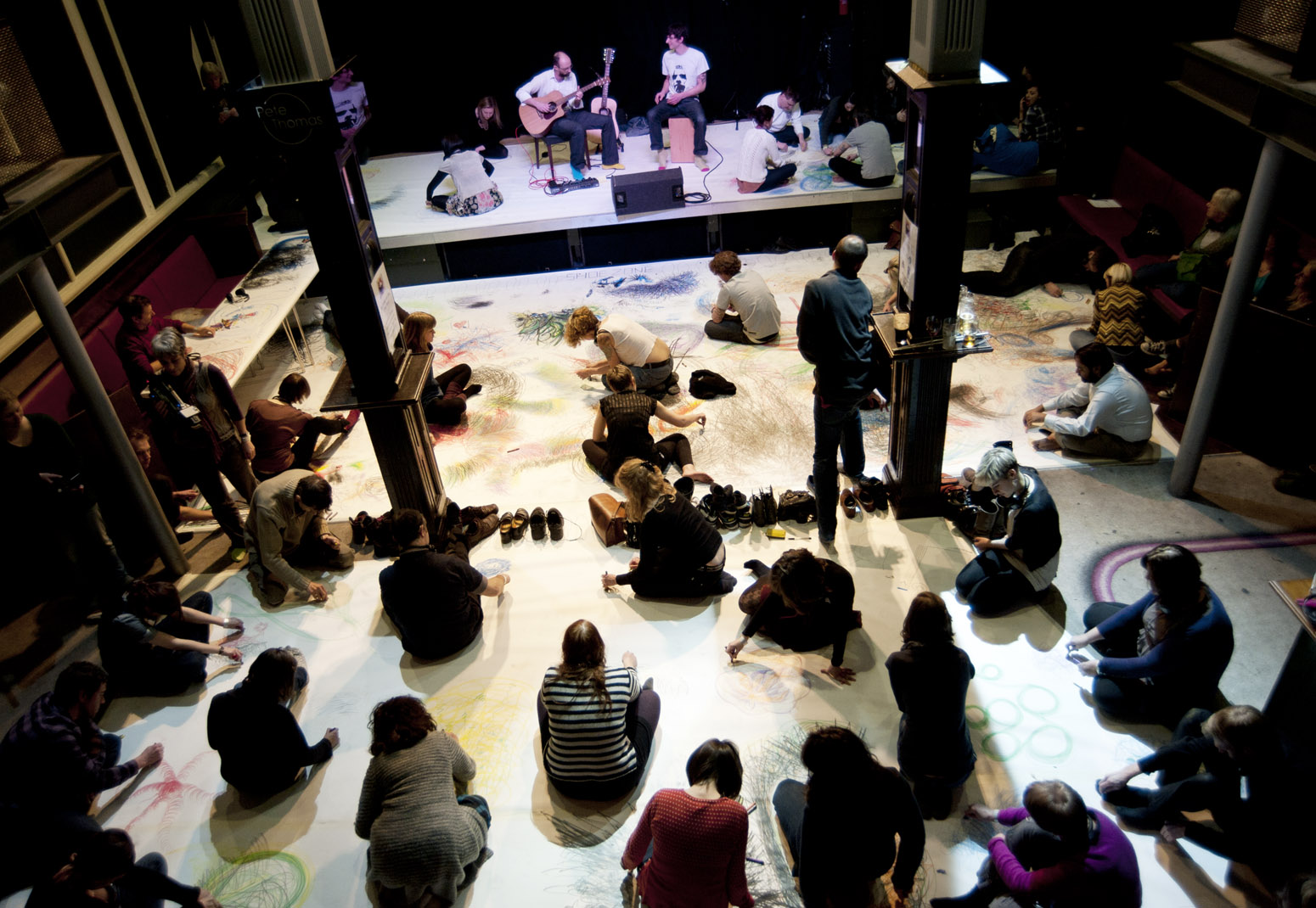

The venue was integral to the event; physically it is a beautiful space, which offered us just enough room to maneuver, a space to view, and the technical capabilities I needed to make it work. I believe the association people have with that space, or type of space, influenced the event too, certainly contributing a great deal to the diverse audience attracted. Some people have and probably always will describe Drawn to the Beat and future participatory art events I do as ‘a workshop’, but I think staging my work at the right venue, at the right time and with the right support from that venue has helped people to realize the difference.
My feelings about Drawn to the Beat change as I digest it. But my overriding memory is of scanning the room, watching people drawing alone, lost in their own worlds, or drawing and even dancing side by side to a favourite song. Then every now and again I would see someone knelt or stood on the paper, surrounded by all this activity, headset on, crayons in hand, just watching what was happening around them. It looked as if they had just woken up.


Link to more Drawn to the Beat Photography by Andrew Brooks and Jacob Russell
http://www.flickr.com/photos/multisensory/sets/72157625959595554/
Thanks to the following sponsors and partners for making Drawn to the Beat Possible: Najia Bagi, Andy Brydon, Andrew Brooks, Huw Wahl, Insa Langhorst, Jacob Russel, James Welch, David Johnson, Paul Balcombe, Amalie Roberts, Chris Briden, Gemma Connell, Elaine Mateer, the Drawn to the Beat Volunteers.
Arts Council England www.artscouncil.org.uk
DaDa Fest International 10 www.dadafest2010.co.uk
Curated Place www.curatedplace.com
Band on the Wall www.bandonthewall.org
Creativity Backgrounds www.creativitybackgrounds.co.uk
Participant's Feedback
'Nice to remember how to be free and let go, enjoy, no restriction, no right, no wrong'
'Love the whole idea and concept really great idea orginal never heard of anything like it. Awesome'
'Energised, happy, I want to do it again – I imagine it could be quite addictive!'
'Made me feel warm, satisfied'
'Music, beats and feet!'
'The music that I would listen to at home that isn’t readily played in clubs was here and to draw it was amazing'
'My favourite part was opening my eyes and being surprised at where I was!'
'I loved it I hope you can make events like this more often, keep it up'
Press and Reviews for Drawn to the Beat
Drawn to the Beat
By Andy Brydon Director of Curated Place
Naomi Kendrick's Drawn to the Beat event at Band on the Wall represented a brave and hugely successful step for the artist who has until recently been better known, at least in the world of sanctioned cultural establishments, for her practice pushing the boundaries of accessibility in museums and galleries than for her output as an image maker in her own right.
Certainly in the world of outreach her reputation precedes her with her practice being recognised as breaking new ground creating experiences that allow disabled, partially sighted and blind people to engage with art exhibitions on a level playing field with the 'able-bodied' and sighted. But often, having words like access, outreach and education associated with your artistic output can be something of a millstone rather than a benefit.
On the one hand working in these fields has given many artists the opportunity to break into the trusted inner sanctum of the gallery world - opening up networks and creating relationships to the places where commissioning decisions are made and exhibitions are planned (as well as helping pay the bills). However, all too often by creating relationships within establishments as 'the access expert' means that artists are then perceived as nothing more than that - falling into the trap of becoming institutionally compartmentalised by senior staff who talk of them in hushed tones behind closed doors as "being a bit 'community'".
The irony is that most of the public and trust-based funding dished out over the past decade has been fundamentally justified on the strength of this kind of work - creating legacy and extending the reach of the institution beyond the privileged and elite. However, its widely understood within galleries and museums, though rarely talked about openly, that most curators and gallery directors programme not for audiences, or even artists, but for their peers - other curators.
In the cultural landscape over the past 15 years or so this outlook has proved a winning formula. Many of those that have progressed into museum and gallery senior management have developed careers and secured regularly funded positions by establishing themselves as brokers of taste and artistic excellence by ensuring their intellectual output appealed to those in a position to give them their next career break - generally not artists. In addition, while it would be unfair to sat that the majority have developed successful careers without having any regard for their audiences, it is fair to say that audiences have been featured a lot more prominently in the education and outreach provision of institutions that have grown to sit alongside, rather than integral to, curated programmes.
While this preaching to the choir approach has been successful in the boom times, and led to the championing of the arts as a cornerstone of UK Plc, the drastic stripping back of the public purse that we're only experiencing the beginnings of leaves the frontline of the art world in a significantly different position that even 12 months ago. No longer is there the cash flow to drop in a rock-star YBA to substantiate your city's claims to cosmopolitanism, nor can wild architectural gestures any longer be justified merely on their status as "iconic". What is required to justify prolonged investment into the arts from both the public and private purse, is art that simultaneously engages and enriches audiences without neglecting the aesthetic or intellectual rigour that gives those of us already bought into the importance of maintaining a healthy cultural and creative ecosystem a firm belief in its long-term value and worth.
It's telling then that Kendrick, as an artist that has done her apprenticeship at the audience facing coalface of the cultural world, decided to deliver her highest profile solo event to date, outside of the structures of the institutions that have, over time, come to neglect that aspect of their function in what they deliver as a headline product.
Both devising and delivering Drawn to the Beat Kendrick successfully blurred the boundaries of curated show and participatory experience and, in doing so, demonstrated that it is possible to deftly walk in the shoes of arts facilitator and artist having shrugged off the burdens of being regarded as an 'outreach specialist' without disregarding the wealth of experience she has gained working face to face and hand in hand with audiences. Indeed, it is her skill in communicating the creative process, no doubt learnt by spending more time in galleries when audiences are actually there than any curator could imagine, that enabled the participants in Drawn to the Beat, to unashamedly and wholeheartedly participate in her work.
Prior to the event it was easy to see that Kendrick's concept of music drawing had the potential to create beautiful work, her own pieces first publicly featured in Blank Media's recent Blankmarket show being snapped up by collectors even before the exhibition had even officially opened. However, while collectors buying an artist's work may bolster confidence in their creative process it is another thing entirely to then extending what is a personal creative practice into a public space. In doing so Kendrick demonstrated a huge amount of courage to release her concept onto an untrained, unvetted and unknown audience that I've rarely seen within 'the institution' and showed a generosity to share her approach that an artist more accustomed to working in the mould of the individual genius - sheltered and hidden away from their audience's reach - would have shied away from, fearing their personal artistic expression be shown up as unremarkable.
What was remarkable, seeing the evening unfold, was that Kendrick's own works remained as stand out pieces of art created using her music drawing approach without ever undermining the experience of those participants that came along to do their own.
Stood in the room on the mezzanine of Band on the Wall it was easy to understand why. Looking down on the hundred or so people freely expressing their personal attachment to the music I was, for a moment, overcome with the feeling of being a voyeur. A feeling exacerbated by the use of silent disco to pipe the evening's dual soundtracks direct to participants personal headphones rather than through a room filling PA. Whilst watching without donning headphones myself it felt as though I was been given privileged, albeit illicit, access to the inner-states of those listening - a state that left me incapable of criticising their creative output on account of the immediacy and freedom of expression unmediated by structures of external aesthetic hierarchy. Later, grabbing a pair of headphones and jumping into the silent disco experience, (albeit still as a spectator rather than a participant), that experience of being ill equipped to criticise a truly personal response was transformed into a remarkable opportunity to empathise with the self-choreographed movements of a room full of people all reacting to the same soundtrack in their own unique way.
The resulting drawings were of wildly varying quality when viewed objectively, some wonderfully free and brilliant, others disappointingly contrived. However, having been external spectator, semi-connected eavesdropping voyeur and ultimately a fully-fledged participant it became clear that the process itself succeeded in being a beautiful work of art on multiple levels. Rewarding as both a communal experience and a means of nurturing individual expression Draw to the Beat achieved a rare feat in a world, like the institutionalise gallery, increasingly defined by the growing chasm between self and other - it connected people. It just so happens that when Kendrick does it herself it also results in spectacular art.
Andy Brydon is a curator and creative producer specialising in explorations of contemporary urban cultures that challenge traditional institutions. His hands-on, immersive approach straddles the void between curator, storyteller and artist, delving into all aspects of popular culture including music, film, photography and gardening. He is the director of arts production company Curated Place and responsible for the exhibitions Haçienda 25: Fac491, HomeGrown: The Story of UK Hip Hop, and Reality Hack: Hidden Manchester with Andrew Brooks. He is also the festival producer for the 2011 FutureEverything festival in Manchester.
www.curatedplace.com
Links below to further press for Drawn to the Beat
South Manchester Reporter -13th January 2011
Curated Place - 15th January 2011
Arts Council England News - 28th February 2011
Blankpages (Blank Media Collective) - 1st March 2011
By Andy Brydon Director of Curated Place
Naomi Kendrick's Drawn to the Beat event at Band on the Wall represented a brave and hugely successful step for the artist who has until recently been better known, at least in the world of sanctioned cultural establishments, for her practice pushing the boundaries of accessibility in museums and galleries than for her output as an image maker in her own right.
Certainly in the world of outreach her reputation precedes her with her practice being recognised as breaking new ground creating experiences that allow disabled, partially sighted and blind people to engage with art exhibitions on a level playing field with the 'able-bodied' and sighted. But often, having words like access, outreach and education associated with your artistic output can be something of a millstone rather than a benefit.
On the one hand working in these fields has given many artists the opportunity to break into the trusted inner sanctum of the gallery world - opening up networks and creating relationships to the places where commissioning decisions are made and exhibitions are planned (as well as helping pay the bills). However, all too often by creating relationships within establishments as 'the access expert' means that artists are then perceived as nothing more than that - falling into the trap of becoming institutionally compartmentalised by senior staff who talk of them in hushed tones behind closed doors as "being a bit 'community'".
The irony is that most of the public and trust-based funding dished out over the past decade has been fundamentally justified on the strength of this kind of work - creating legacy and extending the reach of the institution beyond the privileged and elite. However, its widely understood within galleries and museums, though rarely talked about openly, that most curators and gallery directors programme not for audiences, or even artists, but for their peers - other curators.
In the cultural landscape over the past 15 years or so this outlook has proved a winning formula. Many of those that have progressed into museum and gallery senior management have developed careers and secured regularly funded positions by establishing themselves as brokers of taste and artistic excellence by ensuring their intellectual output appealed to those in a position to give them their next career break - generally not artists. In addition, while it would be unfair to sat that the majority have developed successful careers without having any regard for their audiences, it is fair to say that audiences have been featured a lot more prominently in the education and outreach provision of institutions that have grown to sit alongside, rather than integral to, curated programmes.
While this preaching to the choir approach has been successful in the boom times, and led to the championing of the arts as a cornerstone of UK Plc, the drastic stripping back of the public purse that we're only experiencing the beginnings of leaves the frontline of the art world in a significantly different position that even 12 months ago. No longer is there the cash flow to drop in a rock-star YBA to substantiate your city's claims to cosmopolitanism, nor can wild architectural gestures any longer be justified merely on their status as "iconic". What is required to justify prolonged investment into the arts from both the public and private purse, is art that simultaneously engages and enriches audiences without neglecting the aesthetic or intellectual rigour that gives those of us already bought into the importance of maintaining a healthy cultural and creative ecosystem a firm belief in its long-term value and worth.
It's telling then that Kendrick, as an artist that has done her apprenticeship at the audience facing coalface of the cultural world, decided to deliver her highest profile solo event to date, outside of the structures of the institutions that have, over time, come to neglect that aspect of their function in what they deliver as a headline product.
Both devising and delivering Drawn to the Beat Kendrick successfully blurred the boundaries of curated show and participatory experience and, in doing so, demonstrated that it is possible to deftly walk in the shoes of arts facilitator and artist having shrugged off the burdens of being regarded as an 'outreach specialist' without disregarding the wealth of experience she has gained working face to face and hand in hand with audiences. Indeed, it is her skill in communicating the creative process, no doubt learnt by spending more time in galleries when audiences are actually there than any curator could imagine, that enabled the participants in Drawn to the Beat, to unashamedly and wholeheartedly participate in her work.
Prior to the event it was easy to see that Kendrick's concept of music drawing had the potential to create beautiful work, her own pieces first publicly featured in Blank Media's recent Blankmarket show being snapped up by collectors even before the exhibition had even officially opened. However, while collectors buying an artist's work may bolster confidence in their creative process it is another thing entirely to then extending what is a personal creative practice into a public space. In doing so Kendrick demonstrated a huge amount of courage to release her concept onto an untrained, unvetted and unknown audience that I've rarely seen within 'the institution' and showed a generosity to share her approach that an artist more accustomed to working in the mould of the individual genius - sheltered and hidden away from their audience's reach - would have shied away from, fearing their personal artistic expression be shown up as unremarkable.
What was remarkable, seeing the evening unfold, was that Kendrick's own works remained as stand out pieces of art created using her music drawing approach without ever undermining the experience of those participants that came along to do their own.
Stood in the room on the mezzanine of Band on the Wall it was easy to understand why. Looking down on the hundred or so people freely expressing their personal attachment to the music I was, for a moment, overcome with the feeling of being a voyeur. A feeling exacerbated by the use of silent disco to pipe the evening's dual soundtracks direct to participants personal headphones rather than through a room filling PA. Whilst watching without donning headphones myself it felt as though I was been given privileged, albeit illicit, access to the inner-states of those listening - a state that left me incapable of criticising their creative output on account of the immediacy and freedom of expression unmediated by structures of external aesthetic hierarchy. Later, grabbing a pair of headphones and jumping into the silent disco experience, (albeit still as a spectator rather than a participant), that experience of being ill equipped to criticise a truly personal response was transformed into a remarkable opportunity to empathise with the self-choreographed movements of a room full of people all reacting to the same soundtrack in their own unique way.
The resulting drawings were of wildly varying quality when viewed objectively, some wonderfully free and brilliant, others disappointingly contrived. However, having been external spectator, semi-connected eavesdropping voyeur and ultimately a fully-fledged participant it became clear that the process itself succeeded in being a beautiful work of art on multiple levels. Rewarding as both a communal experience and a means of nurturing individual expression Draw to the Beat achieved a rare feat in a world, like the institutionalise gallery, increasingly defined by the growing chasm between self and other - it connected people. It just so happens that when Kendrick does it herself it also results in spectacular art.
Andy Brydon is a curator and creative producer specialising in explorations of contemporary urban cultures that challenge traditional institutions. His hands-on, immersive approach straddles the void between curator, storyteller and artist, delving into all aspects of popular culture including music, film, photography and gardening. He is the director of arts production company Curated Place and responsible for the exhibitions Haçienda 25: Fac491, HomeGrown: The Story of UK Hip Hop, and Reality Hack: Hidden Manchester with Andrew Brooks. He is also the festival producer for the 2011 FutureEverything festival in Manchester.
www.curatedplace.com
Links below to further press for Drawn to the Beat
South Manchester Reporter -13th January 2011
Curated Place - 15th January 2011
Arts Council England News - 28th February 2011
Blankpages (Blank Media Collective) - 1st March 2011
Subscribe to:
Posts (Atom)


 Posts
Posts

